London

From The Fifth City Wiki

"Fallen London: once capital of the British Empire, now home of the Bazaar. Deep. Dark. Expensive. Marvellous. Here you can find everything from immortality to unnervingly good mushroom wine."[1]

"The Bazaar stole London three decades ago. Of course only anarchists and revolutionaries say 'stole' any more. Everyone who matters has grown to know and love the status quo. It's quiet down here. All those jewels and mushrooms and all that black water. What could be better?"[2]

Now known as Fallen London or the Fifth City, London was formerly the capital of the British Empire... until it was kidnapped by the Bazaar and its Masters and placed in the lawless cavern called the Neath, in exchange for the life of Empress Victoria's Consort.

The Fifth Fall[edit | edit source]

"Forty years ago, London was stolen by bats."[3]

Around forty years ago, Prince Albert, the beloved Consort of Queen Victoria, succumbed to typhoid,[4] plunging the Queen into inconsolable grief.[5] In her despair, she accepted an offer from the enigmatic Masters of the Bazaar: Albert would live again but at the cost of the British capital itself.[6] Thus, on February 14, 1862, the Fall of London into the lightless depths of the Neath occurred.[7]

After the Fall[edit | edit source]

In February 1862, with no warning at all, London fell through the surface of the Earth. This was meant to be a year of progress and industry. The Great Exposition. Trams. A new sewer system. Instead, we find ourselves dwelling in a cave. It's October now. The fires have been put out. The bodies have been buried. But the future remains unimaginable; the time before, impossibly distant.[8]

London has at last settled into its place in the Neath. Its citizens have grown accustomed to the cavern's strange humours, and the screaming has, for the most part, ceased.[9] The city is markedly different from the one that once stood beneath the open sky. Its geography, its culture, its politics, all have been reshaped by the descent into the depths.

Geography[edit | edit source]

"The streets of London were bent into a labyrinth with the Bazaar at the labyrinth's heart. Finding your way around can be troublesome"[10]

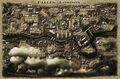
A map of Fallen London

Things have changed since the Fall, and the names of streets, buildings, and locations have been replaced[11] - but more strangely, as the years pass, Londoners have begun to notice that new maps contradict their predecessors (let alone the illegal ones from before the fall).[12] Perhaps there are just no worthy cartographers in this city; but seasoned zailors and geography professors have reported similar observations all over the Neath.[13] For someone standing just under the spires of the Bazaar, the directions to any other point of interest would be the same, but the route would be different each time.[14][15] There are rumors about a map of London so precise that it can even track the smallest deviations of each road.[16] But if something like this existed, it would be locked away from the public - the Masters don't like it when people dig too deep.[17]

A newer map of Fallen London

It is said that London has seven labyrinths.[18][19][20] No definitive list of these mazes is known. The Streets of London are considered one of them due to their tendency to shift unpredictably,[20][21] the Law is said to be to be the Fifth Labyrinth[22][23] and there is speculation that the human heart is the Seventh Labyrinth.[24] Other mazes such as the Labyrinth of Tigers, the maze surrounding the Orphanage,[18] the Last Labyrinth,[25] or even the human heart may be counted among the Seven Labyrinths, but this is unconfirmed.

Culture[edit | edit source]

"The trouble began when London fell. You could get away with anything really in the old days. No one batted an eyelash if you murdered a neighbour for salt. Scenes straight from Boccaccio conducted in all of the great houses. But, all good things must come to an end. When it became apparent that death was the least of anyone's worries, people gradually began to return to the familiar."[26]

Down here, your name is whatever you say it is. Often there's no one left to remember who you used to be. Some people hold tight to the names they carried before. Some reinvent themselves completely.[27]

London's culture has changed as dramatically as its skyline. The shock of the Fall, the influence of the Masters, and the uncanny nature of the Neath have all played a part in reshaping the city's customs.

Marriage laws were expanded: anyone may now marry anyone(s),[28] regardless of gender; relations once reviled (and still is) on the Surface are commonplace.[29] This shift was not merely organic social progress, but an intentionally effort on the parts of the Masters, moulding London's dreams and, allegedly, its water supply.[30] Officially, the Anglican Church still disapproves, but reform-minded clergy and the God's Editors have pushed it toward cautious acceptance.[31]

A gift mushroom. It's all the rage these days.

Fashion,[32] foods,[33] and seemingly everything else has taken on a decidedly fungal aspect. The arts have splintered into five major schools: the Nocturnals, revelers in darkness and midnight hues; the Celestials, who long for blue skies and Surface pleasures; the Bazaarines, inspired by the Echo Bazaar itself; the Mycologenes, whose muse is the Blemmigans; the Terpsichoreans, who look to the devils' dances.

Death, or rather its spotty enforcement, has also reshaped society. Most causes of death are now mere inconveniences: a few stitches, a few days, and one recovers.[34] This made it possible for the Game of Knife-and-Candle, a city-wide competitive murder sport, to become popular.[35] It eventually was outlawed by Mr Iron and replaced with Mr Hearts' more… selective poison-based Game.[36] Inheritance laws, too, had had to adapt to this new reality. As the elderly linger indefinitely, fortunes pass only once an individual is legally declared dead and shipped off to the Tomb-Colonies.[37] Funeral celebrations for the still-living, legally deceased but socially present, have become the norm.[38][39]

Yet not everything has changed. The British stiff upper lip persists, and Victorian propriety, though battered, remains recognisable: women are still not enfranchised;[40] marriage is still expected;[41] the upper classes still throw lavish parties at the expense of everyone else,[42] and inheritance law still favor men over women.[43] Xenophobia has merely found new targets: the squid-like Rubbery Men,[44] and the dutiful, uncomplaining Clay Men from Polythreme.[45][46]

Politics[edit | edit source]

"The Masters apply peculiar customs duties: to fish below a certain size, to green ribbons but not red, to speckled eggs but not plain. Perhaps their strangest tax is a heavy duty on stories of love: but it only applies to stories leaving the Neath..."[47]

"Do you not see [...]! Every year, the Bazaar... she devours us! From within! The rich dream honey-dreams, while the poor shovel lacre with their bare hands in the streets - just to earn a few Echoes to buy food... and above it all the Masters and the -"[48]

The Empress

London is no longer the capital of the British Empire, though many of its old institutions persist in diminished form. The Queen has sealed herself and her household inside the Shuttered Palace,[49] and has forbidden the use of her name.[50] Loyalists still call her Her Enduring Majesty, but most Londoners prefer the less charitable Traitor Empress (for, you know, selling out her nation's capital city to a bunch of shifty robed merchants).[51]

The Masters of the Bazaar

In theory, the Empress rules alongside the Masters of the Bazaar.[52] In practice, her self-imposed exile has left the Masters with de facto control.[53] Parliament has been neutered, its authority hollowed out;[54][55] the office of Prime Minister abolished.[56] Any law the Masters desire is dutifully approved.[57][58] They have created a proliferation of new Ministries and Departments to manage the city's affairs.[59][17][60] Fortunately for London, their requirements are few: trade restrictions on dangerous curiosities, censorship of politically inconvenient writings, and, most mysteriously, an unwavering insistence on strict tariffs for exported romance novels.[61]

Despite being cut off from Surface Britain, London clung to its old imperial ambitions. The Neath became a new frontier, an opportunity for conquest, new jewels to replace the ones lost in the Fall. The disastrous Campaign of '68, the Army's ill-fated attempt to invade Hell,[62] ended in humiliation and many concessions to the devils.[63] In contrast, the Carnelian Campaign secured London its lone colonial possession: Port Carnelian in the Elder Continent.[64][65]

Trade and contact with the Surface now depend on the Cumaean Canal and the Travertine Spiral.[66] Because the Sun forbids anything Neathy from surviving in its light, goods and people can travel downward without much trouble, but not the other way around. Surface Britain has moved on: Manchester now governs,[67] and many former colonies have either declared independence or openly consider it.[68][69] The Admiralty, already crippled by the loss of its entire fleet, stranded above after the Fall, [70] has apparently come into internal conflict over an engineering project down south.

Not all Londoners accept the status quo. The so-called dynamite faction, a loose coalition of revolutionaries: socialists, anarchists, foreign agents, plots to overthrow both the Empress and the Masters.[71] Their most formidable organisation, the Calendar Council, consists, if rumour is to be believed, of twelve shadowy figures, each adopting the codename of a month.[72]

Genius Loci[edit | edit source]

"Are you quite sure you want to know this?"

This page contains spoilers for the following Fallen London endgame content: The City in Silver. Proceed at your own risk.

You can find out more about our spoiler policy here.

"Can you begin to encompass the inventory? Dizzying millions of women and men, dogs and cats, pigeons, rats, fleas. (There was a plague here, more than once.) Sewers and trams and roads, and rivers now threaded under the roads and between the sewers. Churches and synagogues and the subterranean shrines of Londinium. The withered roots of trees that died when the Sun withdrew. Bones."[73]

"London fell mere decades ago: a blink, in so long a life. Neath dark is a recent misfortune. It remembers the Surface, and everything sun-gilt above: the Great Fire, Shakespeare in his Globe, Gloriana in her golden scull. It remembers the sunken Spaniards, and Suleiman's disdain."

"It remembers its middle ages the way an old man remembers his first year of university, as a time of puckish incident. The lights were brighter then, and the taste of wine was new."[74]

A person is an assembly of organs that together produce a consciousness with a name; so too is a city an aggregate of individuals, edifices, customs, and ambitions that cohere into an identity.[75][76] A city, by virtue of this composite life, stands as a living being upon the Great Chain of Being. And if it is alive, then it must possess a mind, a temperament, a spirit. A genius loci.[77]

London came into being as most cities do: gradually, through the work and will of many people, rather than through the sudden metamorphosis of a single soul, as has occurred with certain other cities in the Neath.[78] The Neath itself occupies little space in London's dreaming; its decades beneath the earth are a brief flicker against the long and storied span of its life.[79] It remembers forests in its youth. It remembers the breadth of its reach, the imperial weight it once swung so freely on the Surface.[80] It considers its Fall a misfortune best not lingered on,[81] and holds in contempt those who sold it and those who profited thereby.[82] Its deepest dislike is reserved for the Empress, who London believes should have forfeited her crown.[83]

Like any living mind, London harbours fears. It dreads Hell, and bitterly regrets its disastrous venture there in '68.[84] These anxieties are real. But they lie beneath a core of swaggering pride for all its wealth and bounties.[85] Above all, London is a city of commerce. Its choices are made as equations of cost and advantage. It is ruthless in suppressing rivals and mercenary in its logic, weighing everything by what yields profit, prestige, or strategic gain.[86] London does not tolerate challengers,[87] and its confidence in its own resilience is absolute.[88] It has endured the Fall, the nearly-Second Fall, the intrusion of the Starved Men, and calamities besides. It is certain, utterly certain, that the fates of the earlier Fallen Cities will not be its own.[89] The Bazaar, London believes, never understood what it purchased. Nor what London is capable of. In its own estimation, the city is the true Master in their relationship, not the other way around.[90]

Map[edit | edit source]


Ladybones Road is a major district of London, rife with mysteries and intrigue.


Veilgarden is a major district of London. Best known for its bohemian leanings, this neighborhood is filled with entertainment, honey-dens, and scandalous delights.


Spite is a major district of London, whose most iconic landmark is St Fiacre's Cathedral. The streets of this impoverished neighborhood are ruled by gangs of urchins who live in the Flit high above.


Mrs Plenty's Most Distracting Carnival is a year-round fair held on the eastern outskirts of London.


Watchmaker's Hill is a major district of London. One of the more dangerous parts of the city, this neighborhood is home to the Department of Menace Eradication, which pays upstanding citizens to hunt various pests in the nearby marshes.


The Forgotten Quarter is the last surviving remnant of the Fourth City.


The Shuttered Palace is the home of the Empress, her Consort, and her children. Why is it shuttered? "Apparently the Empress doesn't like light. Or sudden movements, loud noises, foreigners, treason, peaches. When you're Empress, you can do this kind of thing."


The Flit is an aerial network of rooftops, bridges, and ladders, primarily concentrated above Spite. It serves as respite for urchins and a convenient hiding place for thieves and spies.


Wolfstack Docks is London's single major port, located on the banks of the Stolen River near the western shore of the Unterzee.


"What can you find in the Bazaar Sidestreets? Respectable firms crammed into ramshackle workshops and pokey offices. The rent here is astronomical. But the quick and the hungry turn profits in the shadows of the spires. Just keep your eyes off the carvings up high. And whatever you do, don't fall in love."


Part zoo and part Bedlam (though the real Bedlam is a good distance south), the Labyrinth of Tigers is a curious attraction where the tigers are the only exhibits who may roam freely.


Concord Square

The headquarters of London's Constables.


Moloch Street is a major artery through Ladybones Road. Its landmarks include the Brass Embassy - Hell's stronghold in London - as well as the Moloch Street Underground Station, which serves as the eastern terminus of the Moloch Street Express and the Great Hellbound Railway.


Hangman's Arch

A common site of public hangings, despite the unreliability of death in the Neath.


A vast and ancient network of tunnels beneath London, inhabited by many Clay Men.


The Brass Embassy is Hell's bastion in London, and thus a base of operation for devils.


The Singing Mandrake

A noteworthy tavern in Veilgarden.


St Fiacre's Cathedral

The most majestic landmark of Spite, headed by a rather peculiar Bishop.


The University is London's primary institution of period-appropiate pseudoscience ahem, knowledge and innovation.


The Orphanage, operating under Mr Fires' protection, is a mysterious facility that sits in the heart of Spite's labyrinth.


Doubt Street

The hub of London's newspapers, magazines, and other printed publications.


Mahogany Hall is London's most popular and prestigious theatre. It really does put on a different kind of show each day, just as advertised.


Mrs. Chapman's
Boarding House

A place for those who have nowhere else to go. Alias Horatia's. Location approximate.


Tentergrounds Synagogue

The only known synagogue in London. Location approximate.


St. Albans
Protomartyr

Location approximate.


The Department of Menace Eradication pays brave Londoners to eliminate threats to the city, particularly those in the nearby marshes.


The Medusa's Head

A tavern owned by the Cheery Man.


A marsh on the outskirts of London, crawling with all sorts of strange and dangerous beasts.


An area on the outskirts of London that is littered with deadly-sharp stalagmites.


The Temple Club

"In an unprecedented move, the clandestine and obscure Temple Club has opened its doors to the public. It is a place for free thinkers, radical antiquarians and luminaries of the modern age to gather amidst the ruins of the Fourth City."


The Blind Helmsman

A zailors' pub in Wolfstack Docks.


Hogslain Market


Tucked into a quiet corner of Tyrant's Gardens, Wilmot's End is the base of the Great Game in London, and the location of the Foreign Office.


The Foreign Office is an almost completely autonomous wing of London's government that is responsible for appointing colonial governors of Port Carnelian.


Drowned Parliament

After the Fall of London, the Empress and the Masters of the Bazaar found no further use for Parliament. So it ended up here.


"I've heard tell that there's a fancy club for exceptional sorts. It's on the river, in the shell of some old clock tower. The things that go on there! They'd curl your hair and clench your toes."


Hood's Bridge


Hater's Bridge


The Echo Bazaar is the center of commerce in London.


Flute Street is an ancient Rubbery city that lies beneath London.


The Royal Bethlehem Hotel, formerly the hospital of the same name, is an elite hotel run by a very mysterious manager.


References[edit | edit source]

  1. What's so special about Fallen London?, Fallen London
  2. What's so bad about Fallen London?, Fallen London
  3. Home Page, Fallen London
  4. My Kingdom for a Pig, Fallen London "...enjoyed such invariable good health... and lived so regularly all his life, that the public thought nothing of his illness until they were startled yesterday morning by the bulletin announcing a restless night and the appearance of unsatisfactory symptoms..." [Editor's note: This is a snippet from a newspaper announcing the death of Albert in 1861]
  5. My Kingdom for a Pig, Fallen London "Hushed hallways. Velvet. Black velvet. A scratch as matches flare and candles burn in the blackness. Speak softly, for my head still aches. I cannot bear the sun. Only candles. Bring them closer. I wish to see his face. Bring me the laudanum, quietly, quickly, for my head aches."
  6. Mr Pages: Theories or Manifesto for Archie, Mask of the Rose "Her consort was dying. A loss not to be contemplemitted. We preserved him. In exchange: everything else she possessed. London and all that lies in fluminate propinquity, together with the oddments of the imperial hoard."
  7. "London Stolen By Bats!", Failbetter Games
  8. Unavoidable Interactions, Mask of the Rose
  9. Login Screen Text, Fallen London "Forty years ago, London was stolen by bats. Discover a dark and hilarious Gothic underworld where Hell is close, immortality is cheap, and the screaming has largely stopped… Welcome. Delicious friend."
  10. Why is it so easy to get lost in Fallen London?, Fallen London
  11. Mention the renaming of the Thames, Fallen London "I recount the newspaper story: the Thames is no longer supposed to be called that. They have recommended it henceforth be named the Purchased River, or the Legitimately Acquired Estuary."
  12. Why is it so easy to get lost in Fallen London?, Fallen London "The streets of London were bent into a labyrinth with the Bazaar at the labyrinth's heart. Finding your way around can be troublesome. Pre-Bazaar maps can be surprisingly useful, but they're contraband. Don't be caught with one."
  13. A Navigation Error, Fallen London "The Zee is treacherous; maps of the zee, doubly so. The motions of the false-stars disagree with your dead reckoning: you are not where you thought you were."
  14. Mr Pages: Introduction, Mask of the Rose "The way is serpentine, through streets that do not seem to lead towards the spires at the centre of the city. But each time I look up, it is closer. The spired building on the horizon."
  15. Harjit: New Destinations, Mask of the Rose "This path is more than usually complicated. Several times we stop and retrace our steps. We cannot omit this part of the procedure. Going backwards is part of the route."
  16. Complete your Hoard, Fallen London "You cannot, of course, put everything you know on a single map. You can't draw all of the streets of London on the same sheet of paper. You cannot be completely certain that Ladybones stays where it is charted. But you have nonetheless assembled the most complete cartographical description of London and its environs that has ever been permitted to exist. Try not to stare too hard at the lines that move."
  17. 17.0 17.1 Unavoidable Interactions: Meeting Griz and Archie, Mask of the Rose "Archie: There's a new decree from the Ministry of Cartography and Chirography, that all maps and atlases are tae be surrendered or put on th' fire."
  18. 18.0 18.1 Enter the Labyrinth of the Orphanage, Fallen London "They say there are seven labyrinths in London. Why can't your goal lie in one of the other ones?"
  19. A Rat in a Sewery Maze, Fallen London "They say there are seven labyrinths in London. Does this count as one of them? It's not very grand. The air is ripe with primordial stenches, and you may need a new pair of boots. Where is that wretched beast?"
  20. 20.0 20.1 Neighborhood Noctivagant (Level 60), Fallen London "They say London has seven Labyrinths, and that you know this one like the back of your hand"
  21. Shifting Streets, Fallen London "In the days after the Fall, when the streets were restless and unkind, London reshaped herself. But maps have never stopped being treacherous. [...] you walk streets you've walked a thousand times, and find yourself in unfamiliar places. [...]"
  22. Have a Legal Document drawn up, Fallen London "Mr Huffam tells his readers that the law is an ass. Not so. It is a maze, the fifth great labyrinth of Fallen London. These kindly gentlemen will guide you through the convolutions, for only a small fortune."
  23. The Offices of Baseborn & Fowlingpiece, Fallen London "The fifth labyrinth of London, they say, is the law. This is at the very least a subsidiary maze. They say there are clerks long lost in its shadows who subsist entirely on book-dust and the blood of passersby."
  24. The House of Chimes, Fallen London "Is the human heart really the Seventh Labyrinth of London?"
  25. Your beloved, Fallen London "But you have the key to the Last Labyrinth [...] You pass through the fungus-choked corridors, the pits where the Inhabiters walk, the broken gates. [...] You breach the surface, at last, in an apple orchard just outside Shepton Mallet, through a Neolithic tomb of unlikely age. It's night, but the air is warm, and scented with summer."
  26. The Season of Propinquity, Fallen London
  27. Unavoidable Interactions, Mask of the Rose
  28. Marry the whole d_mn lot of them, Fallen London "The unique nature of your ceremony renders efficiency a virtue. […] The repetition of your vows over and over does nothing to tarnish them […] That night, your lodgings are packed. […] By the morning, your lodgings still throng - but everyone here is yours."
  29. Turn the subject to the Tutor, Fallen London "The Cambridge Tutor steals a glance at Emilio. "I wasn't here at the Fall. I came later, via Naples. Emilio helped get me onto the Canal, and then, well, descent has its own logic." He reaches across the table and takes Emilio's hand. "As for why? Well, there was conversation about me at Cambridge. Accurate conversation, mind, but as things are on the Surface, an exit seemed wise. And we've all heard of London's new liberality." He grins at Emilio. "And a handsome Neapolitan smuggler proved the final incentive.""
  30. Turn the subject to its life and business, Mask of the Rose "We find ourselves speaking of the fate of London, and the changes intentionally made. The cavern of the Neath will naturally change it in certain ways, 'loosening the physilegal restrictions'. Other alterations are down to the Masters' deliberate efforts, according to Mr Pages. The laws of marriage are rewritten; inhibitions of affection vigorously countermanded. Mr Pages is coy about how this is accomplished, though it makes reference to water and to dreams."
  31. The Brass Grail, Fallen London "Officially, of course, the Church doesn't approve. But I've always found a place in the clergy for men like me, as long as they're discreet. [...] But now, everyone's hopping into bed with men and women and squid-heads and God alone knows what else while we're as chaste as church-mice. Someone at St Cyriac's has been expanding the theology. Paving the way through references and glosses for a change in doctrine so that we should all be tumbling about with whoever we like. I should have realised it was James' doing!"
  32. Sporing Bonnet, Fallen London "Are those really mushrooms? If they are, why do they whisper so? How is it they have taken root in your hair, and in your dreams? Who is Madame Limpid?"
  33. Tin of Murgatroyd's Jellied Mushroom Cakes, Fallen London "More of a biscuit, really. And more of a mould than mushroom. Still, after eating one, you are more attuned to the world around you and its opportunities. Especially those opportunities that in no way involve jellied mushroom."
  34. Sidebar Snippets: What happens when you die in Fallen London?, Fallen London "Death in the Fifth City isn't necessarily the end. If you're stabbed or shot, someone may come along and sew you back together soon enough. If you're drowned, you'll wake with a hangover. If you die of old age or disease, or if you're hacked to pieces, it's a more serious matter. But in any case, once you die and return to life down here, you'll never be permitted to return to the surface...unless you're one of the few who find a way to immortality."
  35. Sidebar Snippets: What is the Game of Knife-and-Candle?, Fallen London "Death is not always permanent in Fallen London. This permits the practice of the violent but strangely boyish game of murderous gentlemen's tag called the Game of Knife-and-Candle."
  36. The Gamekeeper's Cottage, Renovated, Fallen London "Mr Hearts has taken over Iron's old cottage near Watchmaker's Hill. From there, it runs a new game: A game of poison and delight."
  37. Admit puzzlement over the lack of an obituary, Fallen London ""Peers cannot simply transfer their title, [...] It passes to the heir – after their death. But Gussie missed Aunt Gertie terribly, and managing the estate was taking a heavy toll on him; so he made arrangements. [...] The title passed to Edwin as planned; and once he'd recovered, Gussie left for the tomb colonies." Gussie, then, is only legally dead, for the purposes of inheritance. Why not simply ask him who should receive the necklace? "Don't be absurd. Asking the deceased to adjudicate inheritance? How gauche. [...]""
  38. Unto Dust, Fallen London "They have a proposal for you: they would like you to arrange a funeral. Their client, a Grand Baron of ancient house and illustrious renown, is about to enter the Grand Sanatorium, the final resting place of many a tomb-colonist. In London, one does not arrange one's own funeral. That would be vulgar. That task falls to his heir, but in the Baron's words he is 'a feckless fop and a flibbertigibbet'."
  39. Unto Dust, Fallen London "The most important moment in any funeral are the toasts – the final farewells, exculpatory remarks and last send-offs to the new tomb-colonist, on their way to Venderbight. The honour of the main toast is given to one closest to the somewhat deceased. [...]"
  40. Deliver the sash to the Blithesome Overseer, Fallen London "Perfect! Well, for the test – I'm not convinced that the outcome will be as desired. It's all very well to give women the hope of democracy, but if they don't already have it— It all depends on whether those supporting the women's suffrage moment outnumber those who fear it."
  41. Ask F.F. to share a confidence, Fallen London "A gangling, mustachioed gentleman canters down [...] He gives F.F.'s shoulder a fond pat as he passes. Her husband? "Well. [...] That is what we say. [...] It has been a useful convenience. Our 'marriage' meant I could pursue my studies unharassed, and removed from him at least one cause of parental disapproval. [...] He is my closest friend, and the person I trust the most. That's better than most marriages."
  42. Dine with the Determined Doctor, Sunless Sea "Do you not see [...]! Every year, the Bazaar... she devours us! From within! The rich dream honey-dreams, while the poor shovel lacre with their bare hands in the streets - just to earn a few Echoes to buy food... and above it all the Masters and the -"
  43. The Season of Propinquity, Fallen London "The problem was that although he loved his wife, his eyes tended to wander. Particularly unfortunately for the much-lamented Earl, his tastes ran to the sons of the great and powerful of London. "Morals had loosened, in the early years," the Marchioness says while spearing a jelly, "But primogeniture is primogeniture.""
  44. Who are the Rubbery Men?, Fallen London "The Rubbery Men are the ones who resemble squids, a little. They trade deep amber for the tiny blind fish that they eat, and for human music. They seem sad, anxious and very polite. But they are terribly menacing. Faces like squid! Occasionally one is stoned to death in an episode of civic high spirits."
  45. Do they drink tea?, Fallen London "The tea shop is in a quiet side street. The owner is refusing to serve a pair of Clay Men their pot of tea and sponge cake."
  46. Arm-wrestle a Clay Man, Fallen London "You took advantage of the poor fellow. You started before he was ready; you distracted him by singing energetically, and then by pretending injury; and you kicked him under the table. You are cheered, and bought drinks. Clay Men are not popular."
  47. Sidebar Snippets: A tax on love stories, Fallen London
  48. Dine with the Determined Doctor, Sunless Sea
  49. Unavoidable Interactions: Regular Headlines, Mask of the Rose "HER MAJESTY'S PALACE SHUTTERED – ROYAL FAMILY REMAINS UNREACHABLE"
  50. Sidebar Snippet: Where is the Traitor Empress?, Fallen London "The Traitor Empress and her consort live safely in the Shuttered Palace, in the protective custody of the Bazaar. No-one is permitted to use her name any more."
  51. A quick commission: Ode to the Empress, Fallen London "A Swivel-Eyed Old Patriot is going round the Garden offering prizes for poetry celebrating the Empress. He doesn't call her the 'Traitor Empress.'"
  52. Decipher the document, Fallen London "[...] Some restrictions are familiar: a ban on cartography, the imposition of additional taxes, division of authority between signatories. [...]"
  53. The Parliament, Mask of the Rose "Griz: La Reyne le veult. The Queen wills it. That's what the Lord Chancellor must say, in approving the Acts. The Masters may have taken charge of Parliament. And sent all the Parliamentarians to a place of their own choosing. But the Lord Chancellor would not be the Lord Chancellor without the permission of the Queen. The Masters would not have the imprint of legitimacy. If the Queen had not given it. The Queen who hides in her Palace and will not come out to speak to her people. I thought we were better ruled."
  54. Politely distract Huffam, Fallen London "The poor Parliamentarian has probably suffered enough, what with Parliament being in the river and its powers curtailed by the Masters."
  55. An alarming lack of leadership from Parliament, Fallen London "SHALLOW PUPPETS APING THE MOTIONS OF GOVERNMENT! This is like a familiar old song. You almost find yourself tapping your feet as you type. This sort of article has been seen in every newspaper printed since the fall, from the Unexpurgated London Gazette to the Weasel Racing Post. Still, it fills up the inches nicely. And Parliament rarely takes this sort of thing personally."
  56. The Season of Propinquity, Fallen London "Archie was brilliant. Oh, I know the conventionally-minded term almost anyone brilliant nowadays, but Archie was the real thing. He could have been Prime Minister – and a good one – if we still had those."
  57. The Season of Stones, Fallen London "A handful of Parliamentarians, fearful and silent, stand against the mahogany panelled walls. A large, round obsidian table sits in the centre of the room. Three Masters sit at it: hunched, cloaked figures, who're still taller sitting than you are standing. [...] One of the Parliamentarians rushes to pass Mr Stones three scrolls. "For you, Chairman," he whispers, before scurrying back to the wall."
  58. The Season of Stones, Fallen London "Only one policy may be given the Masters' approval. Their book of Obligations, which bears the Empress' seal ever so lightly embossed onto the cover, states that they cannot pass more."
  59. Mr Pages: Introduction, Mask of the Rose "Griz: The whole Ministry of Accounting and Recounting is under Mr Pages' direction."
  60. Unavoidable Interactions: Meeting Griz and Archie, Mask of the Rose "Griz: I may not have adequately conveyed to Mr Pages the, ah, leisurely pace of government action. Or the proper scope, come to that. They once suggested a Ministry of Calling Cards, and another for Reflective Surfaces."
  61. Sidebar Snippets: A tax on love stories, Fallen London "The Masters apply peculiar customs duties: to fish below a certain size, to green ribbons but not red, to speckled eggs but not plain. Perhaps their strangest tax is a heavy duty on stories of love: but it only applies to stories leaving the Neath..."
  62. Caught Up in a Soldier's Heartbreaking Tale, Fallen London "Soon we came across the rubbery chaps, devils and so on, and learned that there were lands beyond London's borders. [...] So we mounted up, loaded the pistols and set out to conquer Hell for Her Majesty..."
  63. Attempt to leave, Fallen London "You are free to leave, of course. Though you must know there are certain treaties that can be called upon. Eventualities accounted for, when circumstance requires mitigation. [...] The terms of our settlement after London's sad little sortie were generous."
  64. Join her in her rooms, Fallen London "London was engaged in her Carnelian campaign. And she was losing – until I charted a course through the fungal jungle. One that even the Court of the Wakeful Eye was blind to. The Presbyterate is still furious about London's victory."
  65. Port Carnelian, Sunless Sea "Fallen London's sole Imperial possession. Treasure it."
  66. You Asked, We Answer: Part 2 (and the Scientific Expedition), Failbetter Games "Two thoroughfares connect the Neath to the surface: the Travertine Spiral and the Cumaean Canal. [...]"
  67. Use your discoveries to set Surface and Neathy powers against one another, Fallen London "A word in Manchester wakens resentment: they do not want London to return and claim to rule England after being so long absent."
  68. The Garden Embassy, Fallen London "Before London fell there was an uprising of miners in the colonies. It wouldn't have mattered – but then London disappeared. Since then, the insurrectionists have made a lot of friends. They're no fools – they want information before they act."
  69. The Garden Embassy, Fallen London "The governments of the colonies I represent are looking to the future. There are plans to federate. My father is a new governor, hence my role here. [...] My father and his counterparts have an important decision to make. Should they remain a part of the commonwealth? Or should they strike out on their own?"
  70. Let him tell me whatever he likes while he walks his rounds, Mask of the Rose "The subject turns to Surface politics, and what must be happening up there, now that London has fallen below. Much of the British navy remains above, of course. But what would it be doing now, without its Empress to instruct it?"
  71. Gunpowder and Zeal: the Revolutionaries, Fallen London "Some call them the dynamite faction, but they're very far from united. Socialists, anarchists, foreign agents: only their hatred of the Masters unites them."
  72. Piece your clues together, Fallen London "[...] The Calendar Council is composed of twelve members: each opposes the purview of one of the Masters. [...]"
  73. Know what you are to it, Fallen London
  74. Confer with London, Fallen London
  75. Reach Out to the Mind of London, Fallen London "One needs (you find) new forms of "I" and "we", to speak of these entries on the chain. A diminished "I", for speaking of the agency of a part of oneself: that is how London would speak of the deeds even of its mayors, its poet laureates, its queen."
  76. Reach Out to the Mind of London, Fallen London "One needs an elevated "we" for a collective that is not a mere plural of separate individuals, but a systemic organ. A way to speak of deeds and consequences that are not yours, are not even the result of a conspiracy, but arise from the inevitable interaction of all the elements in the system."
  77. Cheat, Fallen London "The Treacheries are transgressions against the Chain. A city, of whatever scale, has a mind, and therefore sits upon the Chain. And, therefore, can be betrayed."
  78. Put a question about its foundations, Fallen London "London was born as most cities are: slowly, from many different people, not as the transformation of any one alone. [Tracklayer's City] is the exception here. Some might say an offensive exception, but London has seen a great deal in the Neath. It is broad-minded on such matters."
  79. Walk the dreams of London, Fallen London "London does not dream of the Neath, not really. It is a flicker in the ever-shifting panorama with which London paints Parabola. Silty shores, tidal flats. Legions in red and gold. A chariot from the east, bearing provincial liberators. But London has made her choice; to the spoils, the victor. There are ships, galleons, later ironclads. They swell London's pride and self with the richness with which they adorn it. Back, there are giants, from Cornwall, from Troy. There are heroes and kings on the streets, Brutus and Aeneas, Joseph of Arimathea and Arthur Pendragon. A playhouse sits in the round, and a Queen in the gods. [...]"
  80. Offer a fresher memory of the Surface, Fallen London "You offer up the recollection and London receives it with mingled gratitude and mockery. The sky was thick with coal-fog when it fell. The streets were full of lamps. Its memories of forest are centuries more ancient still, tangled oaks and the king's huntsmen. And your palatial estate is not even in England, is it? There's something off about the colour of the squirrels. But oh it does remember how it was to have room. To stretch its influence outward in every direction. Not to be kept in this cave like a chicken in a pot."
  81. Confer with London, Fallen London "London fell mere decades ago: a blink, in so long a life. Neath dark is a recent misfortune. It remembers the Surface, and everything sun-gilt above: the Great Fire, Shakespeare in his Globe, Gloriana in her golden scull. It remembers the sunken Spaniards, and Suleiman's disdain. It remembers its middle ages the way an old man remembers his first year of university, as a time of puckish incident. The lights were brighter then, and the taste of wine was new."
  82. Turn your attention to your own leaseholding, Fallen London "It recognises with resentment, because those who gave you that lease did not really have the right to do so; ancient perquisites were ignored in the haste to meet your demand. Do you observe the Ceremony of Quit Rents? Where are the nails and horseshoes that you owe each year to the Queen?"
  83. Walk the dreams of London, Fallen London "You are laid out on a slab of stone. It is dark. You don't hear the familiar call of gulls, the coo of pigeons. Those have been eaten, or taken away from you. There is only the dark, and the bats, and the avarices around you. Who knew hunger had stone knives? They lay you out, and argue. They continue arguing even as they begin to cut and whirl. They argue over the best method of rearranging your innards. Nothing will go back the way it was. And worst of all, they plan to divide you further, into neat, extractive dominions. And the one who sold you, she is permitted to keep her crown."
  84. Submit your prisoner to the ministrations of Hell, Fallen London "The Grey Man has feared these walls for decades, even though he has existed (in this form) only for a few months. He whimpers as you get closer. He asks you to relent. London came this direction in '68, and it was sorry, very sorry, to have done so."
  85. Walk the dreams of London, Fallen London "[...] On the river, that once had a name, life teems: mudlarkers and smugglers and thieves. They, too are vital. London does not discriminate between high and low, vice and virtue, the cargo it sells and the cargo it buys. All glorifies, all expands. In the face of this hoard, the Neath is an interregnum, visited briefly between fonder remembrances."
  86. Defy London, Fallen London "If the city prefers to fade into utter insignificance, then by all means, go ahead and wall it away from London. It will not be the first city to die in the Neath, nor the last. The idea does not much interest London. It had an interest in futures, in gains to come. But if there is nothing to possess, then there is no reason to concern itself. Its attention is already slipping away from you; there is business on the docks, a load of fresh wares from the Khanate."
  87. Make a case for restraint, Fallen London "The prime meridian runs through Watchmaker's Hill; London does not make maps on any other basis. London's navel is the Londonstane, the limestone marker in Artillery Road from which all distances are measured. She does not require, nor tolerate, any other centre of mass. Other cities have set themselves against the City of London. Ladybones was once a town in her own right. But all of those are boroughs now."
  88. Remind it of all you and Mr Fires did to further its preservation, Fallen London "[...] It does not like the thought of an incursion; it can see the half-digested remains of the Fourth. But there is with it also a bravado. What city do they intend to drop, then? Surely they don't think to get very many love stories out of Portsmouth or Bristol. They won't find passion in the mills of Manchester. [...]"
  89. Remind it of all you and Mr Fires did to further its preservation, Fallen London "[...] At the bottom of all, a conviction. London survives. It might take damage, perhaps very significant damage. But it will endure. Surely."
  90. Share knives at the feast, Fallen London "Heir of Lancaster. Scion of Threadneedle Street. Shareholder. Have you not known yourself until now? Of course; of course. Various individual aspirations come and go, but nothing escapes from the buying and selling. The Bazaar didn't know what it did, acquiring us. It had no idea. Who now holds the leash?"